La Corruptela
Atta Collective
OCTOBER 17, 2026
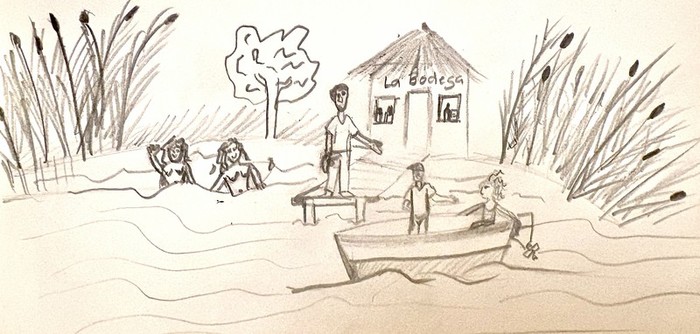
When I told my friend Sergio about my adventures, especially the story of La Corruptela, he was fascinated. As a filmmaker, he immediately said that someone should make a movie about them and that it should be called “La Corruptela.” What I never realized was that, without knowing it, we were already looking at a small preview of what was coming to our country.
When I graduated from university, I was just like any other young woman starting her life: innocent, hopeful, and full of dreams. I had the opportunity to complete my tourism internship at a camp deep in the Venezuelan jungle. It was truly in the middle of nowhere. The only ways to reach it were by boat or by plane, and it was far from any of the country’s populated areas.
The camp was beautiful. It had been built with the help of the Pemón Indigenous people and had everything we needed to live in the jungle for an extended period of time: comfortable rooms, a restaurant, an airstrip, and a generator that provided electricity until midnight. I was completely in love with the landscape, the untouched wilderness, the overwhelming beauty of nature, and the culture and almost sixth sense of the Pemón people.
We received tourists from all over the world, most of them foreigners. Among them, on one occasion, was a group of Spanish television executives. At some point, they asked me whether I would ever consider emigrating, or whether I imagined myself living in Venezuela for the rest of my life.Without hesitation, I told them: “I dream of traveling the world, but I will always come back home, to my beautiful Venezuela.” I had no idea how deeply those words would stay with me.
A few days later, those same Spanish businessmen were talking to one of the maintenance workers at the camp. They mentioned a place somewhere in the jungle called “La Corruptela.” The name immediately caught my attention. I have always been curious, so I asked my colleague what kind of place it was.
His answer surprised me. Deep in that jungle, in the middle of nowhere, besides the Pemón people and the four Venezuelans who lived at the camp, there were also garimpeiros, illegal miners, most of them coming from Guyana, Brazil, and other countries, searching for gold. You could sometimes see or hear their small boats moving through the rivers, extracting Venezuela’s gold. And, as you might imagine, where there are illegal miners operating far from civilization, there has to be somewhere they can obtain supplies.
That place was La Corruptela. Hidden in the middle of the jungle, it was where, on occasion, the camp had to go for gasoline or food when bad weather prevented the small plane from landing on our airstrip.
Being young, curious, and adventurous, I immediately asked my colleague to take me there. He did not want to. But I insisted. So one day, when we ran out of gasoline, he finally agreed.
We headed down the river in a small boat, surrounded by dense jungle and wildlife. Everything was quiet and untouched. Then, suddenly, he slowed the boat. Little by little, he guided us through dense vegetation that looked almost like mangroves. And then the landscape opened. It looked almost like a hidden cove. There was an improvised dock and a small pinkish house made of mud and thatch, serving as a bodega, a small place where supplies were sold.
Then I turned my head. There were women bathing in the river, their bodies exposed, in the middle of nowhere. They were the sex workers serving the garimpeiros.
As we approached the dock, I noticed a tall, thin Black man standing there. He had a gold tooth, and a gun was strapped to his waist.He looked at my colleague and asked him, in English, who I was.
That was when I realized he was Guyanese.
My colleague quietly turned to me and said in Spanish: “Do not say anything. Stay in the boat.” Then he explained why. This was no man’s land.If those men decided they wanted me, they could easily shoot him in the head and throw his body into the river. No one would ever know. He then answered the man’s question, explaining that I was an intern from the camp and that I would remain in the boat.
And that was the end of my adventure in La Corruptela. As we say in Venezuela, “God protects the innocent.” We left. But I carried that story with me for years.
Twenty-two years later
As the years passed, I watched my country deteriorate under socialism, into hunger, poverty, corruption, and misery.Twenty-two years have now passed since that m
oment, and I still remember the words I said to that Spanish businessman. I wanted to travel the world. But I would always come home.
I am no longer the innocent young woman who stood on a boat and looked at La Corruptela from a distance. Unfortunately, I have had to experience it firsthand.
Today, I see that jungle differently. That beautiful, wild landscape has become, in my memory, a representation of Venezuela itself. A country overflowing with extraordinary beauty and natural wealth, while hiding a dark secret within it: a corrupt system that has extracted the riches from its land, allowed illegality to penetrate the heart of the country and its people, contaminated its rivers, and, in many ways, contaminated their souls.
The man with the gold tooth and the gun has become, in my mind, a symbol of that power. Because if I hadn’t stayed in that boat, and I had not been able to leave, I might have disappeared into those waters without anyone ever knowing what happened to me. Or I might have been forced into survival in ways I could never have imagined, just as so many Venezuelans have been forced to surrender pieces of themselves simply to survive in a country that increasingly resembles that forgotten place in the jungle.
A no man’s land. La Corruptela.
Stories & Reflections by Marlyn Gordon
Exploring life through art, memory and creation.